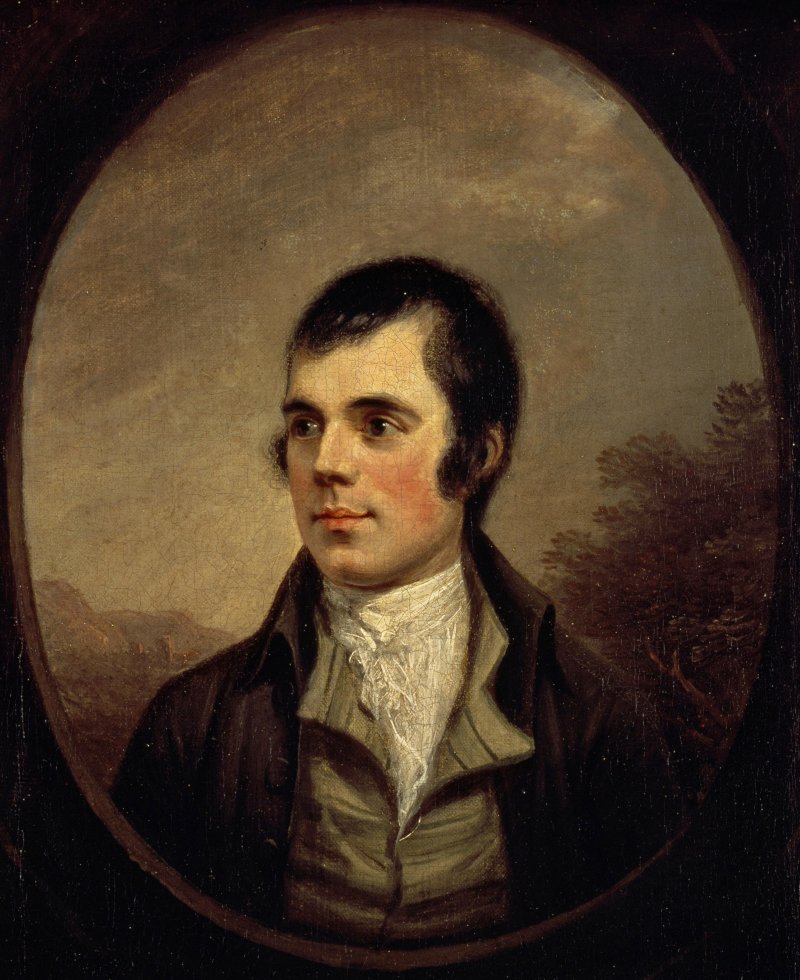
Rabbie Burns,
was a 18th century Scottish poet, lyricist and farmer
who had a love for whisky and who is to this day widely
regarded as the national poet of
Scotland.
 Robert Burns, familiarly known as Rabbie
Burns, was a Scottish poet, lyricist
and farmer who is to this day widely regarded as
the national poet of Scotland. Born on
25 January 1759 in Alloway, Ayrshire,
Scotland, Robert Burns has been
commemorated worldwide by enthusiasts
since shortly after his death on 21 July
1796. Every year, around the world, on
or around his birth date, "Burns
Suppers" are held to celebrate his life
and genius. Robert Burns, familiarly known as Rabbie
Burns, was a Scottish poet, lyricist
and farmer who is to this day widely regarded as
the national poet of Scotland. Born on
25 January 1759 in Alloway, Ayrshire,
Scotland, Robert Burns has been
commemorated worldwide by enthusiasts
since shortly after his death on 21 July
1796. Every year, around the world, on
or around his birth date, "Burns
Suppers" are held to celebrate his life
and genius.
Burns' impact globally remains immense,
even today, though quantifying it can be
challenging. Some aspects of his
influence are subtle; for instance, many
people join hands and sing "Auld Lang
Syne" at New Year's without realising
its authorship.
Burns is held in high esteem by literary
peers and genuinely cherished by
ordinary individuals who appreciate his
poetry and style of writing. This is
evident in the millions of copies of his
works sold worldwide and their
translation into numerous languages.
Burns' writings capture an image of
Scots and Scotland that is embraced
worldwide. He wrote of life, love and
whisky and was a pioneer of the Romantic
movement, and after his death he became
a great source of inspiration to the
founders of both liberalism and
socialism.
Some of his better known poems (and
song) are "Auld Lang Syne" which is
often sung at Hogmanay (the last day of
the year), and "Scots Wha Hae" which
served for a long time as an unofficial
national anthem of Scotland. Other poems
and songs of Burns that remain well
known across the world today include "A
Red, Red Rose", "A Man's a Man for A'
That", "To a Mouse", "The Battle of
Sherramuir" and "Ae Fond Kiss". If
you are not familiar with them, I
recommend you look them up.
Of course this site is about whisky,
which features in many of Burns's poems,
none more so than ,
"Tam o' Shanter"
a wonderful, epic poem in which Burns
paints a vivid picture of the drinking
classes in the old Scotch town of Ayr in
the late 18th century.
In his poem, "John Barleycorn," Burns provides his
perspective on whisky. He indirectly
alludes to the process of harvesting
barley, malting, and distilling to
produce Uisge Beatha (whisky). Once more, Burns
showcases his extensive understanding of
life during that era, particularly with
his depiction of the malting process,
which remains integral to whisky
production today.
John Barleycorn by
Robert Burn's
There was three kings into the east,
Three kings both great and high,
And they hae sworn a solemn oath
John Barleycorn should die.
They took a plough and plough'd him
down,
Put clods upon his head,
And they hae sworn a solemn oath
John Barleycorn was dead.
But the cheerful Spring came kindly on,
And show'rs began to fall;
John Barleycorn got up again,
And sore surpris'd them all.
The sultry suns of Summer came,
And he grew thick and strong;
His head weel arm'd wi' pointed spears,
That no one should him wrong.
The sober Autumn enter'd mild,
When he grew wan and pale;
His bending joints and drooping head
Show'd he began to fail.
His colour sicken'd more and more,
He faded into age;
And then his enemies began
To show their deadly rage.
They've taen a weapon, long and sharp,
And cut him by the knee;
Then tied him fast upon a cart,
Like a rogue for forgerie.
They laid him down upon his back,
And cudgell'd him full sore;
They hung him up before the storm,
And turned him o'er and o'er.
They filled up a darksome pit
With water to the brim;
They heaved in John Barleycorn,
There let him sink or swim.
They laid him out upon the floor,
To work him farther woe;
And still, as signs of life appear'd,
They toss'd him to and fro.
They wasted, o'er a scorching flame,
The marrow of his bones;
But a miller us'd him worst of all,
For he crush'd him between two stones.
And they hae taen his very heart's
blood,
And drank it round and round;
And still the more and more they drank,
Their joy did more abound.
John Barleycorn was a hero bold,
Of noble enterprise;
For if you do but taste his blood,
'Twill make your courage rise.
'Twill make a man forget his woe;
'Twill heighten all his joy;
'Twill make the widow's heart to sing,
Tho' the tear were in her eye.
Then let us toast John Barleycorn,
Each man a glass in hand;
And may his great posterity
Ne'er fail in old Scotland!
There are too many of Burns poems and
songs which reference or have whisky as
its subject to mention here but if you
haven't already read some of his works they are well
worth exploring.
With the anniversary of Burns birth only
a couple of weeks away, 25 January, an
event which is celebrated the world over
with a Burns Supper I thought you may
like to check out my quick guide on
hosting your own Burns Supper as
well as a few whiskies suggestions from what would
be one of Burns local distillery's had
he been alive today. See the links
below.
|