|
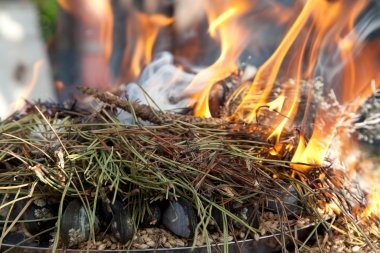
Bowmore Pine-Fired Mussels with Spear-Leaved Orache.
River Cottage’s chief forager John
Wright and head chef Gill Meller have
created a series of delicious recipes
perfectly matched to Bowmore Islay’s
first Single Malt.
This dramatic method for cooking
mussels must be as old as the hills. It
imparts a fantastic flavour to this
forgeable shellfish. I’ve combined them
with a delicate seashore vegetable –
spear-leaved orache, which is similar to
spinach.
Ingredients
Serves
4
- 2 kg mussels (make sure the
mussels are clean and de-bearded. If
you have foraged them yourself they
will need to be thoroughly cleaned
and checked over)
- 1 forager’s basket full of very
dry pine needles
Splash of Bowmore 12 Years Old
- 1 Clove of garlic
- 2 handfuls of spear leafed
orache
- 1 knob of butter
- 1 tbls olive oil
Method
- Scatter a layer of malted barley
over a large metal tray measuring
about 40-50cm in diameter, set this
somewhere outside.
- Take the clean mussels and lay
them all hinge side up and side by
side in a big circle, then lay a
stack of pine needles over the top
about 20cm high.
- Set fire to the pine needles in
several different places all up wind
of the tray and give it a good blow
to get it going. Make sure you have
chosen a suitable place to cook your
mussels, as the fire is quite
dramatic. I cooked ours on top of a
Bowmore cask.
- Once the pine needles have burnt
up (5–10mins) the mussels are ready
to pick out. Be careful because the
shells can be hot.
- Place a pan over a medium heat
and add the butter, olive oil and
garlic. Cook the garlic for 1min
then add the spear-leaved orache,
place a lid on the pan and cook for
2–3mins.
- Add the picked pine fired
mussels and season with salt and
pepper and heat through.
- It’s very important to cook the
mussels properly, especially if
you’ve foraged them yourself, so if
in any doubt bring to a simmer and
cook for 2mins.
- This dish is lovely served in
clean oyster shells.
Foraging
Tip
Spear-leaved orache is one of many
spinach-like wild foods. It is common on
beaches but also in allotment gardens as
a persistent weed. Another, more
familiar species, is Fat Hen – although
bane of the vegetable gardener – it
should be cooked and not thrown on the
compost heap! For those who love seaside
foraging, the sea beet is the one to go
for; succulent and sweet it puts spinach
to shame.
|




 Keep up to date with
the latest whisky news and special
offers
Keep up to date with
the latest whisky news and special
offers