|
An innovative
endeavour aimed at providing a
substantial sustainability uplift to the
Scotch Whisky industry has been
unveiled. The introduction of a
state-of-the-art £45 million Energy
Centre will not only save a remarkable
25,000 tonnes of carbon emissions
annually but also result in cost savings
for consumers.

An innovative initiative has been
unveiled to address two critical issues
plaguing the Scotch Whisky industry:
decarbonisation and the burden of costly
compensation systems imposed on
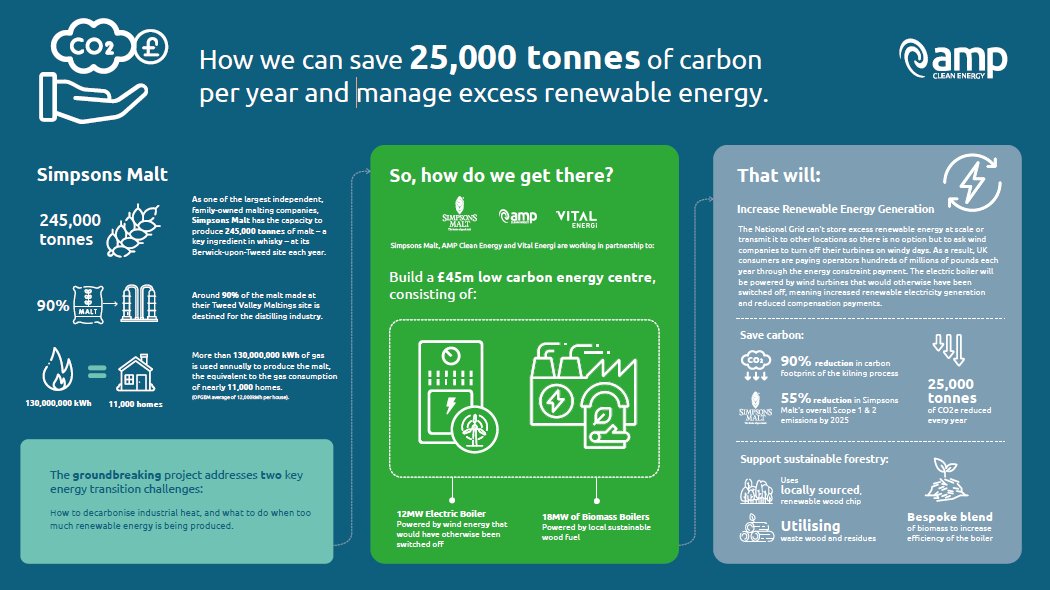
consumers. The groundbreaking £45
million AMP Clean Energy project
introduces a cutting-edge energy centre
at Simpsons Malt Limited's Tweed Valley
Maltings headquarters in
Berwick-upon-Tweed.
This pioneering project entails the
construction of electric and biomass
boilers within the energy centre, which
will replace the utilisation of fossil
fuel gas in malt production—an essential
ingredient in whisky. By implementing
this solution, the project will annually
save 25,000 tonnes of carbon emissions
and the equivalent amount of gas
required by 11,000 homes. Moreover,
carbon emissions at the UK's largest
malting site will be reduced by an
impressive 80%.
What sets this endeavour apart is its
revolutionary utilization of local,
renewable biomass fuel as an energy
storage mechanism. This innovative
approach allows for its deployment
during periods of insufficient renewable
electricity generation, thus
spearheading the electrification of
industrial heat.
A remarkable milestone will be achieved
in the UK, as a high voltage electrical
boiler will be powered by wind energy
that would have otherwise been curtailed
during periods of excess wind. This
breakthrough not only facilitates
increased renewable electricity
generation but also leads to reduced
compensation payments to wind energy
generators.
Presently, the existing energy system
lacks the capability to store surplus
renewable energy at scale or efficiently
transmit it to other locations,
resulting in the unfortunate necessity
of requesting wind companies to halt
turbine operations on windy days. This
scenario compels UK consumers to bear
the financial burden, amounting to
hundreds of millions of pounds annually,
through the "energy constraint payment"
mechanism.
The AMP Clean Energy project serves as a
transformative endeavour that not only
contributes to decarbonisation efforts
within the Scotch Whisky industry but
also presents a viable solution to the
compensation system predicament,
benefiting both the environment and
consumers alike.
Mark Tarry CEO AMP Clean Energy, said:
"We are proud to be able to support
Simpsons Malt Limited on their
decarbonisation journey with this
trailblazing low carbon project that
will deliver large scale Scope 1
emission reductions. This initiative is
so exciting because it uses local, low
value biomass as a form of energy
storage that can provide decarbonisation
when the wind doesn’t blow.
"This is the first project of a kind in
the UK and the first time a high-voltage
electric boiler will decarbonise an
industrial heat process. It could be
replicated across other industries. This
project will save consumers money and
drive forward the broader energy
transition towards a net zero future.
The project is also AMP’s largest single
investment to date."
The biomass boiler implemented in the
project will rely on locally sourced,
sustainable wood chip as its fuel
source. This initiative serves a dual
purpose, not only enabling the
utilisation of previously under-managed
woodlands but also ensuring their
commercial viability.
Considering that approximately 2.5
kilograms of malt are required to
produce a single litre of whisky, the
adoption of this new process becomes
even more significant. With the
implementation of the biomass boiler, an
impressive 275 grams of carbon emissions
will be saved for every litre of whisky
produced. This reduction in carbon
footprint highlights the positive
environmental impact of the project and
reinforces its commitment to
sustainability.
Steven Rowley, Operations Director at
Simpsons Malt Limited, said: "As a
Certified B Corporation, we are
committed to minimising the impact of
our operations on the environment and
operating this Energy Centre at our
Tweed Valley Maltings will be an
important step in our objective of
achieving net zero Scope 1 and Scope 2
emissions by 2030, giving us a company
wide reduction of around 55%.
"As a result, the malt that leaves our
Tweed Valley Maltings – 90% of which is
destined for the distilling industry –
will have a significantly reduced carbon
footprint, helping our distilling
customers deliver on their own
sustainability objectives while also
positively impacting the sector as a
whole."
|