bifter
Master Of Malts

Joined: 10 Apr 2012
Posts: 1403
Location: East Lothian
|
 Posted: Mon May 28, 2012 6:56 pm Post subject: The Bell's Decanters - A Brief History and Tasting Note Posted: Mon May 28, 2012 6:56 pm Post subject: The Bell's Decanters - A Brief History and Tasting Note |
 |
|
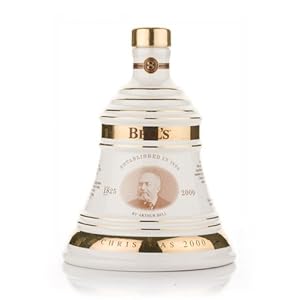
I don't know about you but, growing up, I always associated the name Bell's with cheap (and fairly bland) blended whisky. So when my brother gave me a bell-shaped 'decanter' of Bells Extra Special Limited Edition Christmas 2000 Scotch Whisky (as pictured above) I thanked him, whilst inwardly recoiling at the truly hideous vessel it came in. I was actually grateful for the contents, I always have a bottle of blended whisky on hand for making Whisky Macs and the like. However, whatever the aesthetic appeal of the bottle, when I did a little research I discovered a little more respect for what is actually a long-standing tradition.
In 1825 Thomas Sandeman (of port fame) established a whisky merchant shop in Perth. His partner Arthur Bell was a pioneer of malt and grain whisky blends and he appointed a London agent in 1863, the first whisky firm to do so. Along with his sons, who he drafted in, he built a world-wide business, the whisky finally being branded with the family name in 1896 (or 1904, depending on your source!). However it was in the 1940s, under William Govan Farquharson's chairmanship, that the brand was catapulted into the big time. The company slogan 'Afore ye go' was used heavily to promote the brand in the US and UK and, by 1980 Bell's was the leading brand in the UK, a position it still holds. In 1985 Bell's was acquired by the Guinness Group, which was ultimately to become part of Diageo.
The bell-shaped decanters began life in the 1920s, being made from blue glass. The production of blue porcelain vessels began in the '30s. By the late '40s Carvendale's of Edinburgh were producing them (the designer was Rolly Carter who ran a famous pub in Thistle Street called Jolly Carter's). Each decanter was hand-made, lettered in gold and came with a clapper attached to the bottom. The production changed in 1949 to Royal Doulton (who revised the design to a brown and gold version), again in 1960 to Spode and once more, in 1966, to Wade. In 1988 the design was once more revised with a new bell shape and new colours of tan and cream. Various sizes were offered over the years though the production costs of the smaller decanters and European legislation have resulted in a single standard volume of 70cl.
In addition to the standard issue decanters a series of seasonal and commemorative releases have been issued, including the marriage of Charles and Diana (quite collectable apparently!), the birth of Prince William, the Queens 60th Birthday and various other royal occasions. The christmas editions have followed the pattern of 4 year series, with the design then changing e.g. 1992-1995 featured images of the 'Art of Distilling': 1992 celebrated cooperage; 1993 the Maltmans Art; 1994 the Blenders Art; 1995 the Cellermans Art. My edition, the 2000 Christmas release, features the Bell's Cherrybank Centre in Perth, former headquarters of the brand and now owned by Scotland's Garden Trust (after being gifted by Diageo in 2002).
So, my decanter is part of a long and distinguished history, however I don't think I'll be keeping it for my mantlepiece. But what of the contents? Well, foregoing any collector's value (seriously!), I opened the decanter and poured a nip and was actually very pleasantly surprised! There is real depth to this blend and there is a lot going on. As well as the smoothness of the grain, one can really detect the characteristics of malts from the various regions - grass, spice and pepper, caramel and marmalade and even a hint of brine. The mouth-feel is viscous and the finish is respectably long and pleasing. Hunting around for some reviews online I discovered generally complimentary assessments and even some reviewers who believed the brand has distinctly improved on what it used to be. My only quibble would be that the abv is 40%, which is already more heavily watered than I would prefer. ScotchWhisky.net advises that the Extra Special blend is at least 35% malt and that these include Caol Ila and Linkwood. Bell's own Web site references Caol Ila, Glenkinchie, Inchgower, Dufftown and Blair Athol (the latter comprising the main malt constituent apparently) though it isn't clear if this applies to all Bell's products. Ultimately I'll stick mainly to malts but as it says on the side of my decanter...
"Several fine whiskies blended together please the palates of a greater number of people than one whisky unmixed."
Arthur Bell
_________________
"Whisky is liquid sunshine."
[George Bernard Shaw] |
|




 FAQ
FAQ Search
 Memberlist
 Register
 Profile
 Log in to check your private messages
 Log in


