|
Kythe
Distillery begins production, ushering
in a new era of traditional Highland
whisky.
Newly built Kythe Distillery in Highland
Perthshire has begun production of its
single malt Scotch whisky, marking the
arrival of a new Scottish whisky
distillery with a distinctly traditional
approach to whisky making.
Located at Hills of Bendochy Farm, near
Blairgowrie, Kythe Distillery began
producing spirit in 2026, with its first
casks now being filled and laid down for
maturation. Rather than following the
modern emphasis on efficiency,
automation and high-volume production,
Kythe has been established around a
deliberate return to historic Highland
brewing and distilling techniques, many
of which have largely disappeared from
Scotch whisky production.
The independent distillery's philosophy
is centred on producing a rich,
characterful single malt inspired by the
style of Highland whisky made during the
mid-20th century and earlier. Its
production methods include heritage
barley, floor malting, extended
fermentation in wooden washbacks,
brewer's yeast and, most unusually, a
directly wood-fired wash still.
As Kythe Whisky Maker Angus MacRaild
puts it: "Efficiency is the enemy of
character."
A Highland whisky project 12 years in
the making
Kythe, a Scots word meaning to show,
demonstrate or prove, was first
conceived in 2014 by whisky enthusiasts
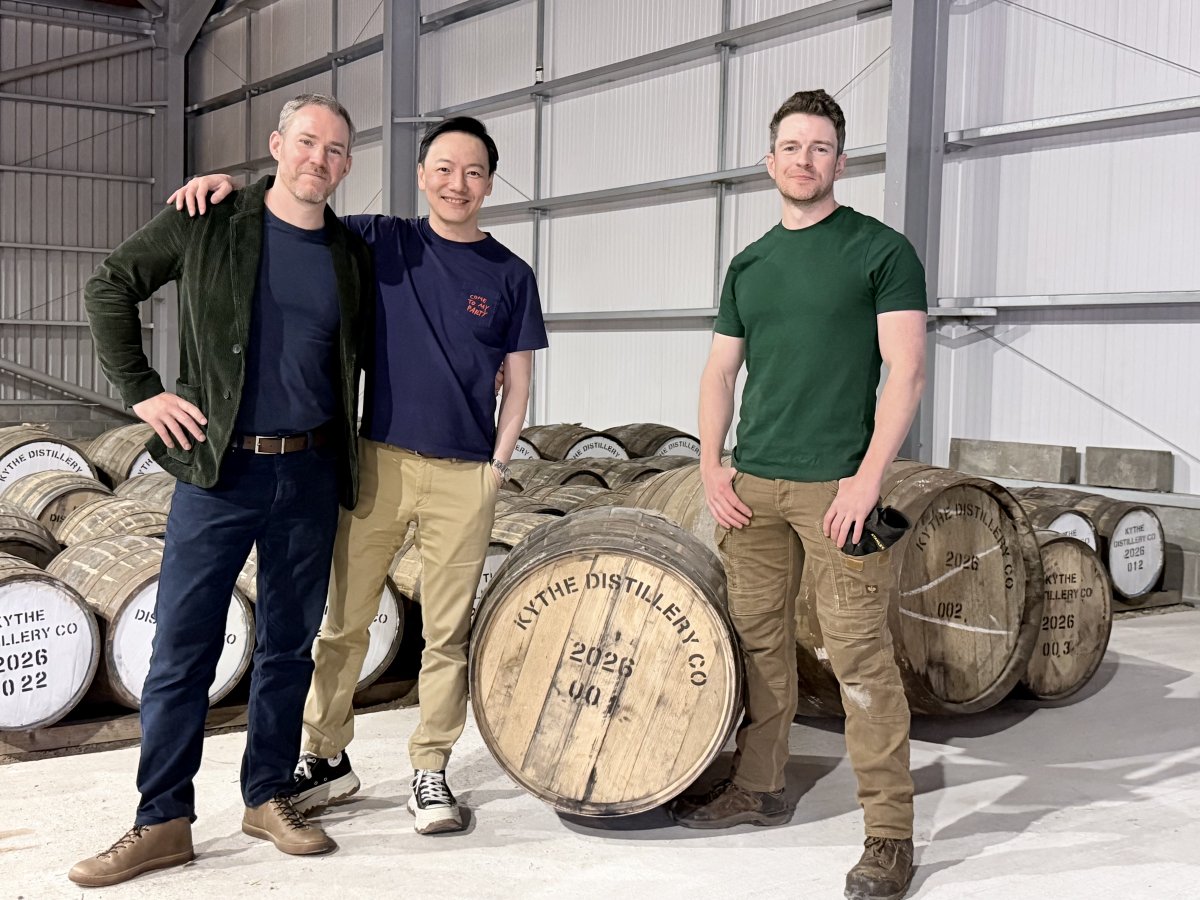
Angus MacRaild, Jonny McMillan and Aaron
Chan. The three founders have spent more
than a decade developing the concept,
drawing on their experience across the
whisky industry and their shared
interest in historic Scotch whisky
production.
Construction of the distillery began in
2024, with commissioning taking place in
early 2026 before spirit began flowing
on 2 July 2026.
The project was born from a desire to
recreate some of the flavours and
characteristics associated with older
Highland single malts by revisiting
production techniques that have become
increasingly uncommon. Rather than
treating traditional methods simply as a
historical reference, Kythe has
incorporated them directly into its
production philosophy.
The result is a distillery designed
around character, flavour and
individuality rather than maximising
yield or reducing production time.
Angus MacRaild, Whisky Maker, said:
"Kythe is a project to make old-style
Highland malt whisky without compromise;
to create something beautiful. We
believe efficiency is the enemy of
character. We want to create a spirit
that is second-to-none in the way of
texture and flavour, using past
traditions to take today’s whisky
forward. When we first explored building
our own distillery we realised that some
of the techniques that are no longer
used are fundamental to the development
of spirit character. Modern day
automation has meant the focus has
shifted to volume and cost-saving
initiatives instead of exceptional,
distinct flavour."
He added: "It's incredibly challenging to work with direct wood
fire; there’s a lack of control,
uncomfortable working conditions and at
its heart it’s messy, but what we do see
as a result of our persistence, is a
spirit that is reviving lost flavours
for the future.
"We are creating something different at
Kythe and hope that the whisky community
will love what we are trying to do and
the spirit that we are making for them."
Traditional Highland whisky production
Kythe Distillery occupies two former
farm buildings at Hills of Bendochy
Farm, a working agricultural site near
Blairgowrie. The converted buildings
house the mash house, stills and onsite
maturation facilities.
Production centres around a 1-tonne mash
tun, a 6,000-litre wash still and a
4,000-litre spirit still, with annual
production targeted at approximately
60,000 litres of pure alcohol (LPA).
One of the defining features of Kythe's
approach is its use of traditional and
heritage production methods at several
stages of the whisky-making process.
Direct wood-fired distillation
Perhaps the most distinctive aspect of
Kythe's production is its directly
wood-fired 6,000-litre wash still. The
technique draws on distilling practices
used in Scotland during the 1950s and
1960s and is now exceptionally rare.
Wood is burned directly beneath the wash
still, with temperatures exceeding
800°C. The Kythe team believes the
process contributes additional depth and
texture to the new make spirit, while
the variability inherent in direct
firing becomes part of the distillery's
character.
Spirit distillation takes place in a
separate 4,000-litre steam-heated spirit
still, with both stills using
traditional worm-tub condensers.
Heritage barley and floor malting
Barley is another important part of
Kythe's attempt to recreate an old-style
Highland single malt. The distillery
currently uses Maris Otter, a
low-yielding, protein-rich heritage
barley that is predominantly grown on
the farm close to the distillery.
All of Kythe's barley is floor malted,
while other heritage varieties are
expected to be introduced as the
distillery develops its whisky
inventory.
Using locally grown barley also
reinforces Kythe's connection to its
Highland surroundings, with the raw
material forming an important part of
the distillery's approach to provenance
and flavour.
Extended fermentation and brewer's yeast
Fermentation is carried out in
traditional wooden washbacks, with the
distillery designed to allow
fermentation periods of up to two weeks.
The extended capacity gives the team
greater flexibility to experiment with
one of the most important stages in the
development of whisky flavour.
Kythe has also returned to the historic
practice of using spent brewer's yeast
alongside distiller's yeast. The
distillery works with Scotland's oldest
working brewery, Belhaven, using spent
brewer's yeast for its fermentations.
This is combined with the original 1950s
pressed M strain of distiller's yeast
following extensive archival research
into historic Scotch whisky production.
Kythe's aim is to create a rich, complex
and fruit-forward new make spirit, with
the fermentation regime intended to
establish the foundations for the exotic
fruit character associated with some
older styles of Highland malt whisky.
Whisky made for character, not
efficiency
Jonny McMillan, Distillery Manager,
said: “Kythe is born of a love for
old-style whisky and a lost lexicon of
flavours that has largely disappeared
from modern whisky making. It is a huge
labour of love for us.”
“From finding the site, to
conceptualising our processes and
beginning production - it’s no mean feat
starting a distillery. And to make
matters more challenging, we’ve added
old highly labour-intensive processes.
However that’s the charm at Kythe. We
don’t want to take any shortcuts with
our spirit - it will take longer to
produce and be more costly, but we are
doing this to create something special
and rekindle a past chapter in Scotch
whisky making. This has always been
about taking our own path to pay homage
to brewing and distilling techniques
that have been left behind in the modern
age of whisky making. And don’t expect a
gift shop any time soon.”
That deliberately independent approach
extends to the maturation strategy.
Kythe is currently filling its new make
spirit predominantly into refill
ex-bourbon and ex-sherry casks, with the
first whisky expected to be bottled in
around eight years, although the
distillery says it will wait until the
spirit is considered ready rather than
adhering rigidly to a predetermined
timetable.
The focus will be on relatively gentle
refill wood that allows the character of
the spirit to remain at the forefront,
rather than relying on highly active or
novelty casks to shape the finished
whisky.
A global community of whisky enthusiasts
Kythe Distillery is unusual not only for
its production methods but also for its
ownership structure. The distillery is
funded by a group of whisky enthusiasts
from more than ten countries, bringing
together people who share the founders'
interest in traditional Scotch single
malt.
Aaron Chan, Chairman, said: "One thing
we are particularly proud of at Kythe
Distillery is that our shareholders are
whisky lovers from more than ten
countries around the world. Every one of
us chose to support this distillery for
the same simple reason: a genuine love
of whisky. We also share a common
ambition to recreate the old-style
whisky that we have all come to know and
love."
The distillery's cask programme is
another extension of that community.
Kythe says its 2025 Cask Owner's
Programme proved highly successful, with
all publicly available casks selling out
online in under six hours. A second cask
release programme is planned for 2026,
giving whisky enthusiasts the
opportunity to purchase and follow the
maturation of their own Kythe spirit.
Old-style methods with a modern
environmental approach
Although Kythe's production philosophy
deliberately looks to the past, the
distillery has also incorporated modern
thinking into its environmental
approach.
Its direct wood-fired still supplies
much of the heat required for
distillation, while electricity powers
the remainder of the production process.
According to Kythe's process engineers,
the distillery's carbon dioxide
emissions can be 94% lower than those of
a standard kerosene-powered distillery
when operated using renewable
electricity.
The equipment has been designed
specifically for Kythe rather than
relying on standard off-the-shelf
systems, reflecting the founders'
willingness to accept higher costs and
greater operational complexity in
pursuit of their production objectives.
The distillery itself has also been
created within existing agricultural
buildings on the working farm, rather
than through the construction of a
purpose-built visitor attraction. There
is currently no gift shop, tearoom or
visitor centre; the focus remains firmly
on producing and maturing the whisky.
The future of Kythe single malt
With production now underway, Kythe's
first new make spirit is beginning the
long maturation process that will
ultimately lead to its first single malt
Scotch whisky.
The distillery expects its inaugural
whisky to be released in approximately
eight years, although the founders have
made clear that maturation will be
dictated by the character and quality of
the spirit rather than an arbitrary
release date.
For Kythe, the objective is not simply
to establish another new Scotch whisky
distillery, but to explore what Highland
single malt might taste like when
production methods from a previous era
are deliberately brought back into use.
The first Kythe casks are now resting in
the warehouse at Hills of Bendochy Farm.
Later this autumn, whisky enthusiasts
will also have the opportunity to
purchase their own Kythe cask, extending
the distillery's journey from a
long-standing idea into a new generation
of Highland single malt whisky.
|